
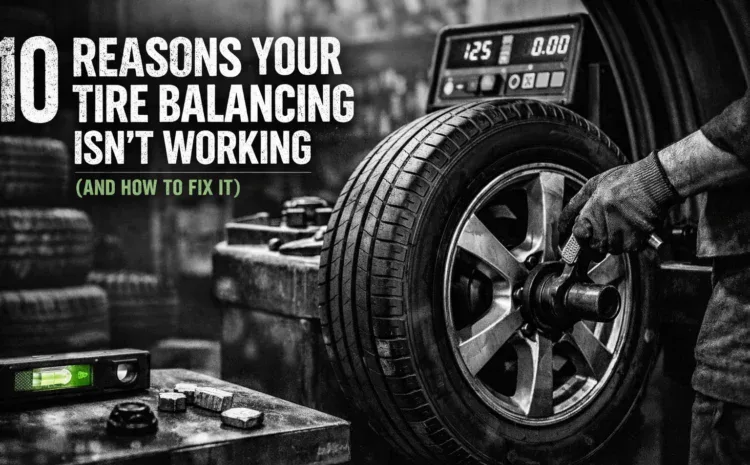
10 Reasons Your Tire Balancing Isn’t Working (And How to Fix It)
You’re merging onto MoPac or hitting that long stretch of SH-130 toward the Circuit of the Americas (COTA). You expect a smooth, effortless glide: the kind where the car feels like an extension of your own body. But instead of a buttery ride, you feel it: a rhythmic, nagging vibration creeping through the steering wheel or humming under your seat. You just had your tires balanced last week. Why is the "shimmy" still there?
At Black N Rounds ATX, we’ve seen this story a thousand times. With over 35 years of Silverstone racing pedigree under our belts, we know that a tire isn’t just a round piece of rubber; it’s a high-performance instrument. In the world of elite racing, a balance issue isn't just an annoyance: it’s the difference between a podium finish and a DNF.
When your daily driver doesn't feel right, it’s often because standard tire shops treat balancing like a "set it and forget it" chore. But true precision requires an expert eye. Here are the 10 real reasons your tire balancing isn’t working, and how we fix it to get you back to that track-day-ready feel.
1. The Disappearing Act: Lost Weights
Think of wheel weights like the tiny counter-balances on a high-end watch. If one falls off, the whole mechanism loses its rhythm. Standard adhesive weights can fail due to poor surface preparation or extreme temperature swings: something we know all too well in the Austin heat. If the technician didn't degrease the rim properly before sticking that weight on, it’s likely sitting somewhere on the shoulder of I-35 right now.
The Fix: We use high-grade adhesives and ensure the mounting surface is surgically clean. If you’re a track enthusiast, we even offer specialized taping methods to ensure weights stay put during high-G maneuvers.
2. Manufacturing Imperfections: Heavy Spots
No tire is perfectly round or perfectly uniform in weight. Every tire has a "heavy spot" created during the manufacturing process. Similarly, every wheel has a "low spot." If these aren't "match-mounted": meaning the heavy spot of the tire is lined up with the light spot of the rim: you’ll have a permanent imbalance that no amount of lead weights can fully fix.
The Fix: We utilize Road Force Balancing, which simulates the weight of the vehicle on the tire to identify these spots and align the tire to the rim with mathematical precision.

3. The Ghost in the Machine: Suspension Wear
Sometimes the problem isn't the tire at all; it’s the "contact patch" (the part of the tire touching the road) reacting to worn-out hardware. If your shocks, struts, or bushings are shot, they can’t dampen the natural oscillations of the tire. This makes even a perfectly balanced wheel feel like it’s bouncing. It’s like trying to run a marathon in high-end sneakers with a broken ankle: the shoes aren't the problem.
The Fix: A comprehensive wheel alignment and suspension check. We look for worn caster/camber components that might be mimicking an imbalance.
4. Flat Spotting: The Morning After
If your car sits for a long time: or if you’ve had to slam on the brakes to avoid an Austin "cedar fever" induced traffic jam: your tires can develop flat spots. The rubber literally flattens where it touches the ground. While some flat spots disappear as the tire warms up, others become permanent structural changes.
The Fix: Regular driving and proper storage. If the flat spot is permanent, you’re looking at a replacement. Check our guide on tire replacement signs for more.
5. Internal Belt Failure: The Silent Killer
Modern tires are masterpieces of engineering, featuring steel and nylon belts hidden beneath the tread. If a belt shifts or delaminates: often due to hitting a nasty pothole: the tire loses its structural integrity. It might look perfectly round on a static balancer, but once it starts spinning at 70mph, it warps and wobbles.
The Fix: This is a safety issue. If we detect an internal failure, the tire must be replaced immediately to prevent a blowout.

6. Nature’s Contribution: Mud and Debris
This is the "low-hanging fruit" of tire problems. A clump of dried Texas mud stuck to the inside of your rim or a large stone wedged in the tread can throw off your balance by several ounces. It sounds simple, but you’d be surprised how many "unfixable" vibrations are just Austin construction site souvenirs.
The Fix: Thoroughly cleaning the wheels before balancing. We don't just balance the tire; we prep the whole assembly.
7. Human Error: Incorrect Mounting
Precision matters. If the wheel isn't perfectly centered on the balancing machine’s spindle, the "zero" reading the machine gives is a lie. Many shops use generic cones that don't fit every wheel hub perfectly.
The Fix: We use "pin plates" and hub-centric adapters to ensure the wheel sits on our balancer exactly how it sits on your car’s axle. Precision in, precision out.
8. Thermal Cycles: The COTA Factor
If you’re a regular at COTA or love a spirited drive through the Hill Country, your tires go through intense "thermal cycles." Extreme heat changes the chemical composition of the rubber, making it harder and less uniform over time. This can cause the tire to "outgrow" its initial balance.
The Fix: For performance drivers, we recommend re-balancing more frequently. Check out our track-day preparation guide for pro tips.

9. The Budget Trap: Poor Quality Rubber
Not all tires are created equal. Budget-tier tires often have higher "lateral runout" (side-to-side wobble) and "radial runout" (up-and-down hop) straight from the factory. You might save money at the register, but you’ll pay for it in ride quality and premature wear.
The Fix: Invest in high-quality tires. We curate only the brands that meet our Silverstone-tested standards for rolling resistance and uniformity.
10. The Pothole Legacy: Bent Rims
Austin roads can be unforgiving. A slight bend in the inner lip of your alloy wheel might be invisible to the naked eye, but it will cause a vibration that no amount of balancing weights can offset. It’s like trying to balance a spinning plate that’s chipped on one side.
The Fix: We check for wheel "trueness" during every balance. If your rim is bent, we’ll let you know your options for repair or replacement before wasting your money on a balance that won't work.

Why "Good Enough" Isn't Enough
In our 35 years of racing experience, we’ve learned that the difference between a car that feels "okay" and a car that feels "alive" is in the details. Balancing your tires is an investment in your vehicle’s total cost of ownership. Properly balanced tires reduce rolling resistance, which improves your fuel economy (or battery range if you're in a Tesla Model 3 or Y), and prevents premature wear on your expensive suspension components.
Don't settle for a vibrating steering wheel. Whether you're commuting through downtown or pushing the limits at a track day, you deserve a ride that is as smooth as it is safe.
Ready to Experience the Silverstone Standard?
At Black N Rounds ATX, we don't just sell tires: we optimize your driving experience. Our expert team uses the most advanced diagnostic equipment in Austin to find the "why" behind your vibration and fix it for good.
Stop the shimmy and reclaim your smooth ride.
Book Your Precision Balancing Appointment Today or visit us at our Austin, TX location to see the difference racing-bred expertise makes.